
Fit In or F@#$ Off! Social Skills, Civic Life, and the Children We’re Leaving Behind
By Amie Milligan, Occupational Therapist | PassionpilOT
Abstract
This piece argues that the public normalisation of contempt for difference — visible everywhere from political rhetoric to a stranger’s t-shirt — is not separate from the work of supporting neurodivergent children and young people. Drawing on affective neuroscience and autism research, it explores how a more hostile civic environment affects the neurodivergent nervous system, why social skills training that ignores context can misplace the problem, and why the same traits that make social navigation harder also make many neurodivergent young people instinctive defenders of fairness. It closes with practical reflections for clinicians, educators, and families on building genuine belonging rather than enforced conformity.
I saw the shirt on a Saturday morning. I was at the petrol station, watching a cluster of teenagers on e-bikes loop the car park. Nearby, a man in his fifties muttered something under his breath. Then I saw what he was wearing: a white tee, bold black letters. Fit in or f*** off. He caught me reading it and smirked.
The shirt wasn’t aimed at the teenagers. It wasn’t aimed at neurodivergent kids, or people with disability, or anyone who struggles to decode the unwritten rules of social life. It was aimed at migrants. At people who look or sound or worship differently. At the kind of difference that a rising strand of Australian political sentiment has decided it no longer has patience for.
And yet.
I thought about my clients.
I thought about the ten-year-old who rehearses conversations out loud before school every morning because the gap between what she means to say and what comes out is still, after years of work, unpredictable. I thought about the fourteen-year-old who moved schools twice before his family found somewhere that didn’t treat his noise sensitivity as a behaviour problem. I thought about the seven-year-old who can spend four hours deep in a Minecraft world he built himself, and who cried last week because he couldn’t work out why the kids at lunch kept walking away.
The shirt wasn’t directed at them. But it is part of the air they breathe. And the message — that difference is an imposition, that those who don’t conform should leave — lands on everyone who already knows what it feels like to be told, implicitly or explicitly, that the way they exist in the world is not quite right.
The Environment Has Changed
There has always been exclusion. There has always been cruelty. I don’t want to pretend otherwise, or to paint some imaginary past as a gentler time. But something is shifting in the texture of public life in Australia and globally, and I think we owe it to the children and families we work with to name it honestly.
The political mainstreaming of contempt — for migrants and refugees, for people living with disability, for people deemed to be asking for too much accommodation, too much flexibility, too much compassion — does not stay contained to the policy debate. It seeps. It becomes permission. It appears on shirts at the petrol station. It shows up in comment sections. It is in the tone of the angry man at the school crossing who has decided that the child walking too slowly, or flapping their hands, or making an unfamiliar sound, is a problem to be managed rather than a person to be met.
For some neurodivergent children and young people, this particular “fit in or fuck off” political moment is collateral — the contempt lands sideways, not head-on. But neurodivergence is not bound by race or migration status, and for plenty of the kids and families I work with, it isn’t collateral at all. Some neurodivergent children are migrants. Some are refugees. Some are people of colour navigating a system that was already built around whiteness as the unspoken default, long before anyone noticed how their nervous system worked. For them, the shirt isn’t aimed elsewhere and catching them in its blast radius. It is aimed at them, on every front at once.
Either way, they are already navigating a world that was not designed for the way their nervous systems work. Now they are doing that navigation in an environment where difference — in all its forms — is increasingly coded as threat.
That matters clinically. And it matters civically.
This Is Not Just a Social Skills Problem
For years, the field of occupational therapy — my field — has worked hard to support neurodivergent children with what we call ‘social skills.’ And there is real, important, meaningful work in that space. But I’ve been sitting with a discomfort lately.
When we talk about social skills in isolation, we risk framing them as a deficit to be corrected (Dallman et al., 2022). Something the child needs to do better so they can fit in — into classrooms, playgrounds, communities that were not, in truth, designed with them in mind. We locate the problem in the child rather than in the system.
But what happens when the system itself is becoming less hospitable? When the social environment we are asking children to navigate is one that is actively practising exclusion at a political level? What does it mean to teach a child to ‘read the room’ when the room has decided that certain kinds of people aren’t welcome?
This is not just a social skills problem. It is a civic one.
The Nervous System in a Polarising World
Here’s a concept from affective neuroscience worth sitting with. Drawing on Dr Lisa Feldman Barrett’s research on interoception and predictive processing, our brains are constantly using internal bodily signals to predict whether the environment is safe or threatening (Barrett, 2017). Not consciously — below the level of thought. Before you’ve decided whether something is dangerous, your body is already responding.
For many neurodivergent children and young people, this system is exquisitely sensitive. Sensory input that others filter out arrives at full volume. The micro-expressions that convey social meaning to most people are harder to read. The unexpected — a change of routine, a shift in tone, an ambiguous message — can tip the nervous system into a state where learning, connecting, and thinking clearly become physiologically difficult.
Now put that child online.
Here’s the paradox: for many neurodivergent young people, digital spaces offer something the physical world often doesn’t — time. The asynchronous nature of text-based communication means you can read a message twice, draft a reply, delete it, try again. There is no eye contact to manage, no ambient noise to filter, no split-second social timing to nail. For a teenager who has spent years feeling like they’re always one beat behind in face-to-face conversation, a Discord server or a text thread can feel like the first place they’ve been on equal footing (Howard & Sedgewick, 2021).
We should not dismiss that. Those spaces are real. The connections formed there are real.
But they are also where the political rage lives. Where algorithms reward outrage and amplify the loudest, angriest voices. Where a young person who has already absorbed — from school, from public life, from a shirt at a petrol station — the message that difference is dangerous, can find themselves deep in a content loop that confirms and intensifies that fear. That the world is hostile. That outsiders are the problem. That the only valid response to not belonging is contempt for those who do.
A child who has spent their whole life on the outside of the social world is not immune to the appeal of a movement that promises them an inside (Wijekoon et al., 2024). Particularly one that offers a clear enemy, a simple story, and the warm illusion of belonging through shared rage.
The nervous system, looking for safety, can mistake intensity for belonging.
Wired for Justice
Here is what I also know. And this part matters just as much.
The cognitive and emotional traits that make the social world harder to navigate — the deep pattern recognition, the sensitivity to inconsistency, the difficulty performing feelings they don’t have, the inability to unsee what they’ve seen — these are not only challenges. They are, in the right conditions, extraordinary civic assets.
Neurodivergent young people are, as a group, neurologically predisposed toward justice (Brosnan et al., 2011). Not because they are morally superior, but because their brains are often wired to notice when the rules are being applied unevenly, to feel the wrongness of exclusion viscerally and personally, and to persist in saying so even when the social cost is high. Many cannot perform indifference. Many cannot look away. Many will keep asking the uncomfortable question long after the neurotypical people in the room have decided it’s time to move on.
History bears this out. The great social movements — for civil rights, for disability rights, for environmental action, for gender equality — have always included, and often been driven by, people who saw the world differently. People who couldn’t make peace with injustice by normalising it. People who found the social cost of conformity less bearable than the moral cost of silence.
We are living through a moment that desperately needs that quality. A moment when cruelty is being repackaged as common sense, when contempt is dressed up as plain speaking, when the loudest voices are telling us that compassion is weakness and difference is threat. This moment needs people who cannot be socially pressured into pretending those things are okay.
Neurodivergent children and young people are those people. They are not a problem to be managed until they can fit in. They are part of the solution to the very conditions that make fitting in feel so dangerous.
What Civic Education Has to Do With It
Democracy, at its bones, requires people to do something very hard: to encounter difference and not be destroyed by it. To disagree without dehumanising. To feel strongly and still listen. To understand that your experience is not the only experience, and that this is not a threat — it is the whole point.
These are not abstract political values. They are relational skills. They require a regulated nervous system. They require practice in environments that are safe enough to make mistakes.
Real civic education — not just learning the three arms of government — is about building the capacity to participate in a shared world. To have a voice. To be heard. To hear others. To hold your own story and make room for someone else’s at the same time.
For neurodivergent children and young people, that education cannot be separated from the other work we do. Teaching a child to understand their own nervous system is civic education. Teaching a family to advocate within a school system is civic education. Helping a teenager understand why a comment thread made them feel unsafe, and what to do with that feeling, is civic education. So is helping them notice when the anger they’re feeling online is genuinely theirs — and when it’s been manufactured for them by someone with a very different agenda.
And conversely: a political environment that normalises contempt for difference does direct damage to this work. Every time a public figure wins applause for telling people to ‘fit in or leave,’ it becomes harder to teach a child that difference is not a deficit. That their nervous system is not a problem to be solved. That they belong in the shared world, and so does everyone else.
We cannot separate the clinical from the political. We can choose not to look, but the children in our care don’t have that option.
And here is the part that I think we in the clinical and education worlds have not said clearly enough: supporting neurodivergent young people to navigate civic life is not charity. It is not accommodation. It is not simply the right thing to do, though it is that. It is strategically essential. If we want a more just, more compassionate, more honest public life, we cannot afford to leave behind the people who are most likely to fight for it.
So What Do We Actually Do?
I am not going to pretend there are easy answers. But there are some things I think about, both in my clinical work and in the design of the programs we’re building at The PassionpilOT Company.
Start with safety, not compliance. A child who is in a state of physiological threat cannot learn social skills — not really. They can learn to perform compliance, which is different and often fragile. The first question is always: does this child feel safe enough to actually be here? What in the environment needs to shift before we ask anything of them?
Name the political context, age-appropriately. Children and teenagers are not oblivious to what’s happening in the world around them. They are absorbing it. Naming it — ‘yes, some people say cruel things about people who are different, and that’s not okay, and it’s not true’ — is not political indoctrination. It is reality testing. It is helping a young person calibrate their understanding of the world against something other than the loudest voices online.
Name their nervous system too. Children and young people who have language for what’s happening in their body when they’re overwhelmed are better equipped to navigate it. Not just because the knowledge is useful, but because naming something reduces its power. You are not broken. Your nervous system is doing what nervous systems do. And the rage loop you fell into last night? That’s also a nervous system response — one that someone designed a platform to trigger.
Name their strengths — and mean it. Not as consolation for the hard parts. Not as the silver lining speech after a difficult week. But as a genuine reframe: the things that make the social world harder for you are connected to the things that make you unusually good at noticing when it’s unfair. Both of those things are true at once. Your pattern recognition, your moral consistency, your refusal to pretend — these matter. The world needs them.
Honour digital spaces without being naïve about them. If online communities are where your child feels most themselves, that matters. It also means supporting them to notice the difference between community and radicalisation, between intensity and belonging, between a space that genuinely welcomes them and one that is recruiting their alienation for someone else’s political purpose.
Reframe the social goal. The goal is not to help a child fit in. The goal is to help them find and build spaces where they belong — which is different. Belonging does not require the erasure of difference. It requires that difference be met with curiosity rather than contempt. That is the kind of social world worth helping children navigate toward — and worth building.
Widen the conversation. Parents, educators, and clinicians are all working with pieces of the same child, in the same social moment. The more we can talk to each other — across professional silos, across the school gate — the more coherent the support becomes. And the more clearly we can say, together: this environment is part of the problem. And these children are part of the solution.
An Invitation
I am one occupational therapist in Canberra, with a clinical background and a long history in international development, who is increasingly convinced that these two parts of my professional life are actually the same question asked in different contexts.
How do people — particularly people who are systematically marginalised — find their voice and use it in a world that is not always glad to hear them? How do we build environments where difference is an asset rather than a liability? How do we hold space for people whose nervous systems, whose communication styles, whose ways of making meaning don’t fit the dominant mould — not so they can perform normality, but so they can participate fully, and change things?
These are civic questions. They are also occupational therapy questions. And right now, in Australia, they are urgent ones.
If you are a parent of a neurodivergent child who is struggling to navigate this world, I want you to know that what you are dealing with is real and it is hard — and it is not a parenting failure. The world genuinely is harder to navigate right now. That’s not your imagination and it’s not your child’s fault. And the qualities in your child that make you most worried — the intensity, the moral certainty, the refusal to let things go — may be exactly what’s needed.
If you are a clinician sitting with the same discomfort I am — wondering whether the social skills goals in the file are really asking the right questions, in the right direction — I’d love to have that conversation.
We need these kids. Not in spite of how their minds work. Because of it.
And if you happen to see a man in a Fit in or f*** off shirt at your local petrol station? I’d gently suggest that the teenagers on the e-bikes are doing something he may have forgotten how to do.
They are trying to figure out how to be in the world together.
That is, when you think about it, exactly what democracy asks of all of us.
Amie Milligan is an occupational therapist and founder of The PassionpilOT Company. She works with families navigating complex systems and is developing Your Flight Path, an online therapeutic education program for families of neurodivergent children. Find out more at passionpilot.com.au.
All client references in this blog are de-identified according to clinical guidelines.
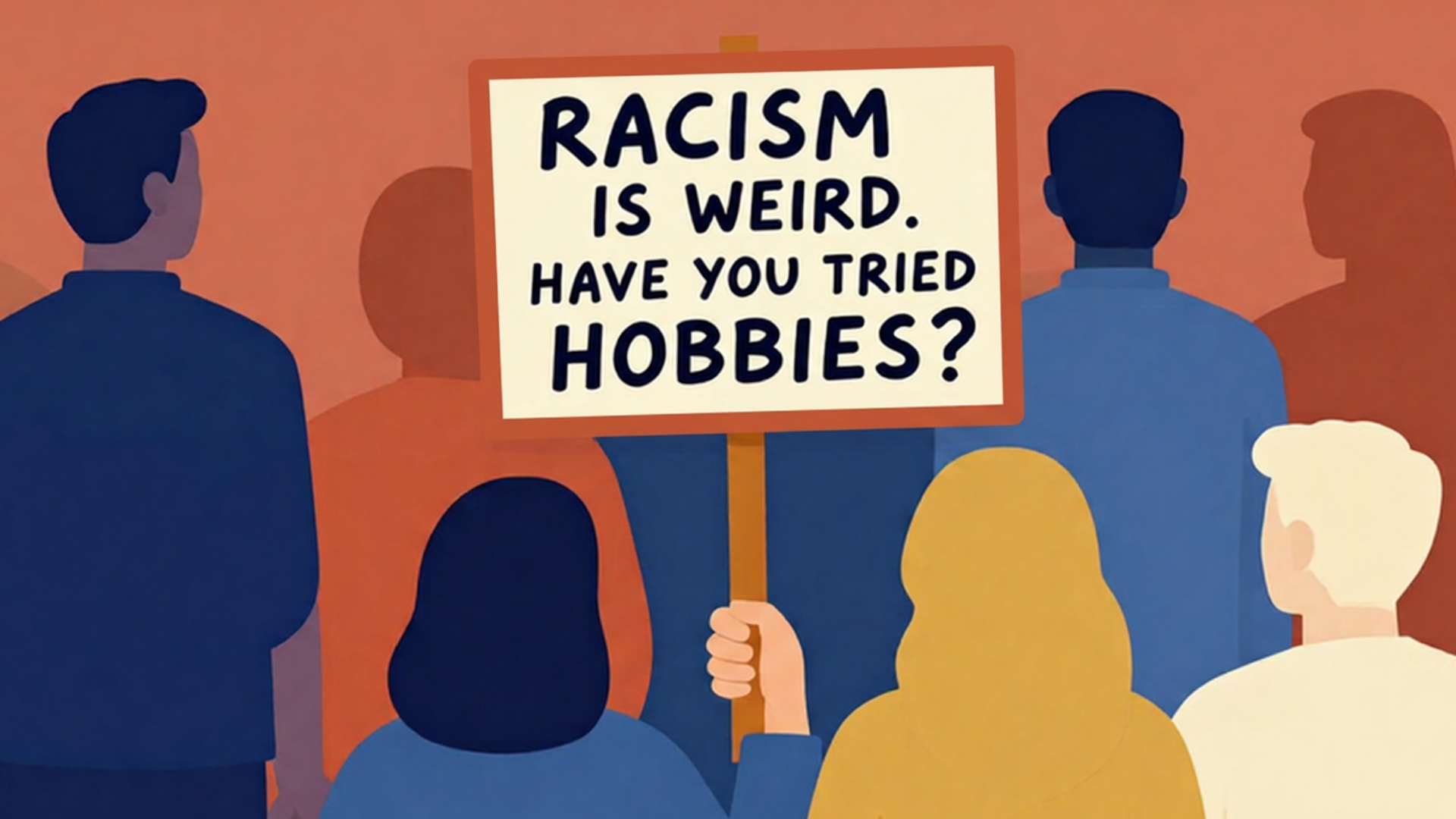
Blog image inspired by anti-racism protests in Glasgow, UK.
References
Barrett, L. F. (2017). The theory of constructed emotion: An active inference account of interoception and categorization. Social Cognitive and Affective Neuroscience, 12(1), 1–23. https://doi.org/10.1093/scan/nsw154
Brosnan, M., Millward, C., Hevey, D., & Keenan, M. (2011). The unusual justice sensitivity of individuals with autism spectrum disorders. Research in Autism Spectrum Disorders, 5(3), 997–1006.
Dallman, A. R., Williams, K. L., & Villa, L. (2022). Neurodiversity-affirming practices are a moral imperative for occupational therapy. The Open Journal of Occupational Therapy, 10(2), 1–9. https://doi.org/10.15453/2168-6408.1937
Howard, P. L., & Sedgewick, F. (2021). ‘Anything but the phone!’: Communication mode preferences in the autism community. Autism, 25(8), 2265–2278. https://doi.org/10.1177/13623613211014995
Wijekoon, S., Robison, J., Welch, C., Westphal, A., Loftin, R., Perry, B., Rombos, V., Picciolini, C., Bosy, C., Senman, L., Jachyra, P., Baron-Cohen, S., & Penner, M. (2024). Neurodivergence and the rabbit hole of extremism: Uncovering lived experience. Autism in Adulthood. Advance online publication. https://doi.org/10.1089/aut.2023.0192